
Sizing
What Size Dumpster Do I Need? An Honest Local Guide
Most guides ask you to estimate in cubic yards. Around here the answer usually turns on whether you are throwing away wood or concrete.
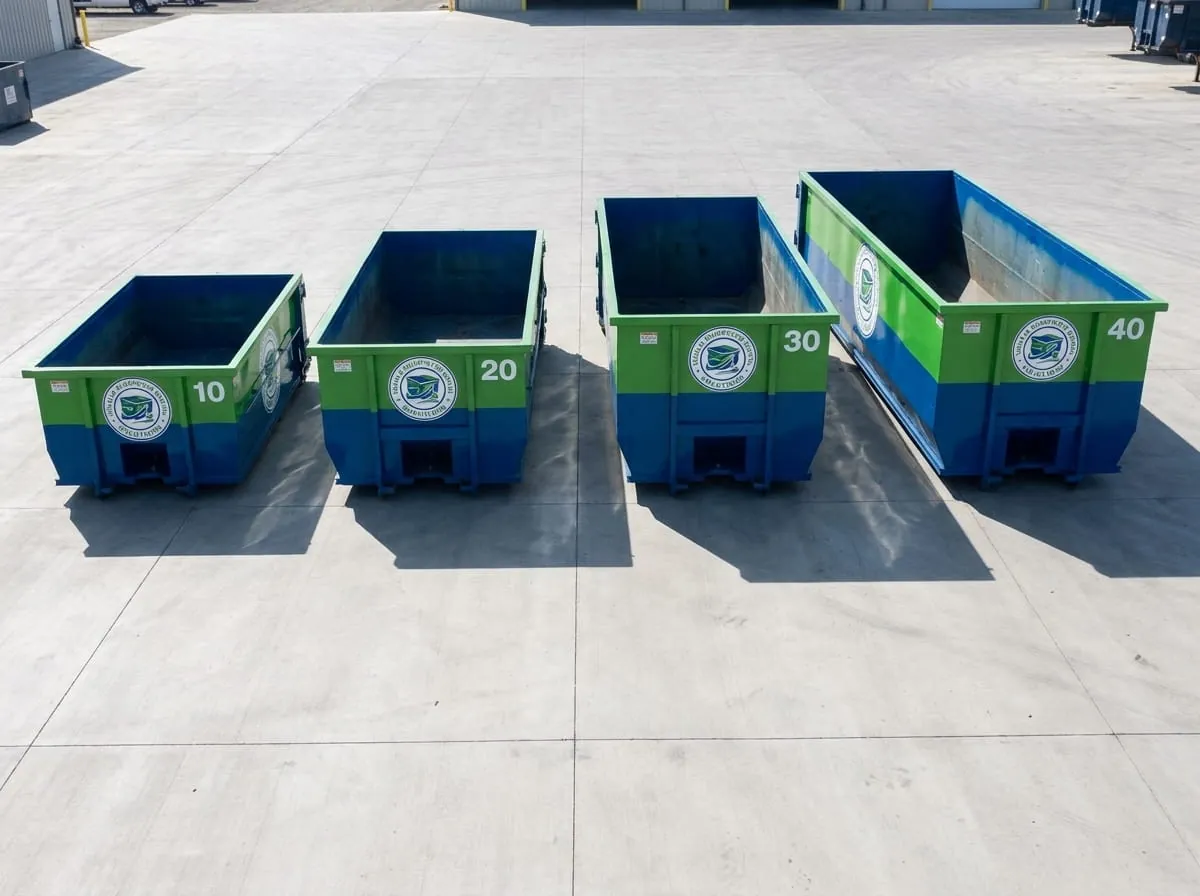
Start with the material, not the number
Very few people can estimate their own debris in cubic yards, and guides that ask you to are not much help. What we actually ask is three things: what are you throwing out, roughly how much in terms you can picture, and where will the container sit.
Those three answers pick the size reliably. The cubic yard figure is just the label on the box.
Volume and weight, and which binds first
Every container has two limits and you will hit one first. Volume is obvious — you cannot load above the top rail. Weight is the one people forget and the one that costs money.
Each size includes a tonnage allowance: roughly one to two tons on a 10 yard, four to five on a 30. Past that you pay a per-ton overage, which we quote before you book.
What each size really holds
10 yard — 12 ft × 8 ft × 3.5 ft
Three to four pickup loads, one to two tons. The small-job container and, more importantly here, the heavy material container: concrete, block, tile, soil and hardpan. Low sides mean you can throw material over the wall without a ramp.
15 yard — 16 ft × 8 ft × 4 ft
Five to six pickup loads, two to three tons. The under-used size, and the one we place most often in the older streets of Farmersville, Lindsay, downtown Hanford and central Exeter, where sixteen feet fits a short driveway and twenty-two does not.
20 yard — 22 ft × 8 ft × 4.5 ft
Seven to eight pickup loads, three to four tons. Our most common residential container, and the default across the newer Visalia subdivisions where driveways are generous.
30 yard — 22 ft × 8 ft × 6 ft
Ten to twelve pickup loads, four to five tons. Same footprint as the 20 with eighteen more inches of height, so it holds half again as much without needing more driveway. The right call for a whole-house clear-out, a grove removal or a job site.
Worked examples from local jobs
| Job | Size | Why |
|---|---|---|
| Bathroom renovation | 10 yard | Small volume; tile and fixtures are dense |
| Patio or driveway slab removal | 10 yard | Concrete runs ~2 tons per cubic yard |
| Block wall section | 10 yard | Masonry — keep it separate |
| Lawn to low-water conversion | 10-15 yard | Sod and soil bind on weight, not volume |
| Kitchen renovation | 15-20 yard | Cabinetry eats volume; tile drives weight |
| Older street, any job | 15 yard | Access is the limit, not volume |
| Composition re-roof, 24 squares | 20 yard | Around 4 tons — at the allowance |
| Full garage and shed clear-out | 20 yard | Bulky and light — fills volume first |
| Three-bed whole-house clear-out | 20-30 yard | Contents fill volume before weight |
| Tree removal, one mature shade tree | 20-30 yard | Cut it down first; it halves the volume |
| Orchard or vine removal | 30 yard, often several | Bulky and light — size up |
| Farm or dairy property clearance | 30 yard | Pull the scrap metal out first |
Orchard and vine wood: size up
The material that defines the high end of sizing in Tulare County.
Citrus, tree fruit, olives, vines — when a block comes out, the volume is extraordinary and the weight is modest. Branches trap enormous amounts of air, so a container looks full long before it is anywhere near its tonnage.
Two consequences:
- Size up, and expect multiple containers on anything larger than a few trees.
- Cut it down before it goes in. This is the single biggest lever on cost that exists in this business. A mature tree loaded whole occupies three or four times what the same tree occupies cut into lengths — routinely the difference between one container and three.
Worth knowing that clean orchard and vine wood is organic waste under state rules and has its own route to a green waste or biomass processor. Keeping it clean — no fencing, no wire, no plastic irrigation line mixed in — is what preserves that route. More on that here.
Concrete and hardpan: size down
The other extreme, and the one that generates overage charges.
Concrete runs around two tons per cubic yard. A 30 yard of it could not be lifted, let alone hauled legally. Slab, footings, driveway, patio and block wall all go in a 10 yard, part-filled.
Hardpan is the local one. Across much of this valley a cemented layer sits under shallow topsoil — hard enough to stop an auger and heavy enough to price like rubble when it comes out. Anyone who has dug a footing or planted a tree here has met it, and any excavation that goes through it produces more weight than the volume suggests.
Soil and sod generally: around a ton and a half per cubic yard. A lawn removal wants a 10 yard part-filled, not the 20 the size of the pile implies.
Separating streams changes the answer
Something specific to working in California, and it affects sizing as well as compliance.
If your job is under a construction debris diversion requirement, you are separating streams anyway — and separated streams size differently from one mixed container. A 30 yard of mixed debris frequently becomes a 10 yard of concrete plus a 20 yard of wood and general material, which is both cheaper to dispose of and easier to document.
Even without a permit obligation, the arithmetic usually favours separation on any job producing real quantities of concrete or clean wood. The compliance side is covered here.
How to describe your job on the phone
- What the material is. "Kitchen cabinets, countertop, appliances and 200 square feet of tile" tells us everything.
- Whether there is concrete, block or soil. Those get their own small container.
- Whether it is orchard, vine or tree work. That changes the answer completely the other way.
- Whether the job is under a diversion requirement, so we set the streams up from the start.
- Which city or unincorporated area — rules and services differ across our three counties.
- Driveway surface, width and any low branches. Visalia's street tree canopy is lovely and occasionally in the way.
Ninety seconds on the phone is the difference between a flat rate that holds and a truck that has to leave again.
Need a container in Visalia?
Call and describe the job. Three minutes on the phone gets you a size recommendation, a flat rate and a delivery window — and we will tell you if a smaller, cheaper container is the right answer.
Call (559) 205-9746