Compliance
Regulation VIII: Dust Control on a Valley Job Site
The rule names property owners, contractors, developers, equipment operators and farmers. If you disturb valley soil, it is aimed at you.
Why the Valley has its own dust rule
The San Joaquin Valley is a basin. Mountains on three sides, an inversion that parks over it for much of the year, and very little wind to clear anything out. Whatever goes into the air here tends to stay in it.
That geography is why the San Joaquin Valley Air Pollution Control District exists as a distinct regional authority and why it regulates dust more specifically than most parts of the country do. The instrument is Regulation VIII, and it is about fugitive dust from outdoor sources.
If you have worked in other states you may have encountered dust rules that apply only above an acreage threshold. Regulation VIII is framed differently — around sources and surfaces rather than a single project size — so it is worth reading rather than assuming.
Who Regulation VIII names
The list is unusually explicit, and it is broader than "big contractors":
Property owners and farmers being named alongside developers matters in a county like this one. A grower clearing an orchard block, a homeowner scraping a large yard and a developer grading a subdivision are all in scope for the sources the rule covers.
What a stabilized surface actually means
The central concept, and it has a definition worth quoting closely because people assume it means "damp".
A stabilized surface is a treated surface that is resistant to wind effects. The test is resistance to wind, not moisture at a moment in time.
The District lists the methods that can create and maintain one:
- Chemical or organic stabilizers
- Road-mix or paving materials
- Vegetative materials
- Water, either soaking the soil or forming a visible crust
Note what the water option actually says: soaking the soil, or forming a visible crust. A light pass with a hose that evaporates in twenty minutes on a July afternoon is not stabilisation in any meaningful sense. In this climate, water alone is a maintenance regime rather than a one-off action, which is why chemical stabilisers earn their cost on anything long-running.
The three situations it covers
The stabilized surface requirement applies to:
- Vacant open areas that have previously been disturbed. The "previously disturbed" part is key — a lot that was scraped last season and left is squarely in scope even though nobody is working it now.
- Unpaved roads and traffic areas. Farm roads, site access tracks, unpaved yards and parking areas. Vehicle movement over dry soil is a dust source in its own right.
- Outdoor bulk storage piles. See below.
The first category is the one that produces surprises, because it applies when no work is happening. A project that stalls between phases does not stop being a dust source; if anything it becomes a worse one, because nobody is watering it.
Bulk storage piles are the one people forget
Spoil heaps, aggregate, sand, road base, screened soil, crushed concrete awaiting reuse — all outdoor bulk storage piles, all named in the rule.
Piles are a particularly efficient dust source because they present a large surface area at an angle to the wind, and because they are usually made of exactly the fine material that travels. A pile that behaves perfectly on a still morning is a different proposition when a north wind comes through in the afternoon.
The practical options are the same as for any surface: treat it, cover it, keep it damp enough to hold a crust, or do not let it sit. On a job producing spoil, the cheapest control is often simply not stockpiling — loading straight out rather than heaping and rehandling.
Practical control on a small site
Most of our customers are not running a hundred-acre grading operation. On a normal residential or small commercial job, reasonable control looks like:
- Wet material before you break it. Cutting or breaking concrete, block or stucco dry produces the maximum airborne fraction at exactly the worst moment. A hose on the cut is the single most effective thing you can do.
- Keep vehicle movement off bare soil where you can, and keep speeds down where you cannot.
- Do not leave a scraped area bare across a windy spell if you can avoid it. Getting to a stabilised state — planted, mulched, base-rocked or treated — is the end of the problem.
- Load straight into the container rather than heaping debris on the ground for a fortnight.
- Watch the forecast. Valley wind events are not subtle and they are usually forecast.
How debris handling affects your dust
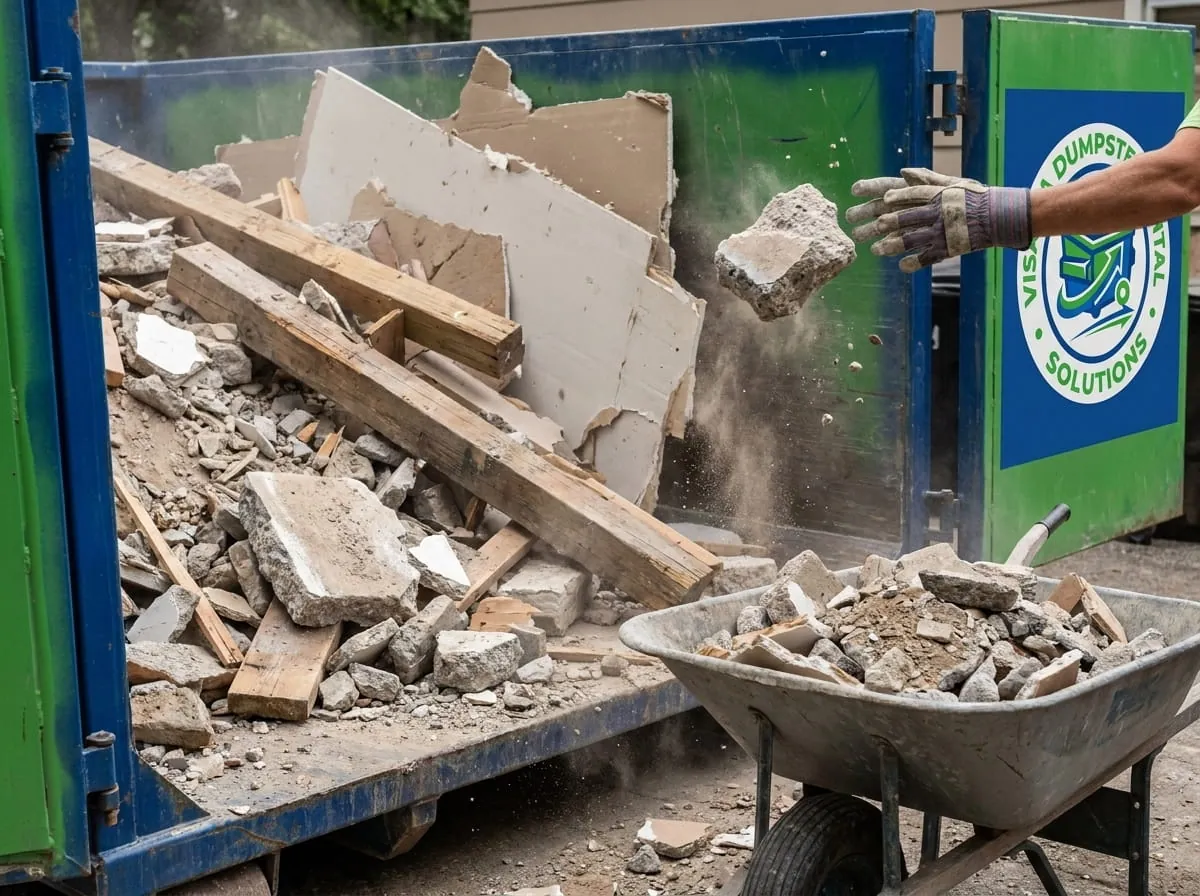
Being honest about the connection: a roll-off container is not a dust control measure. But how you handle debris changes how much dust your site produces, and the two overlap more than people expect.
- Material in a steel box is not a bulk storage pile. A loose heap of demolition rubble on bare ground is a named source; the same material in a container is contained.
- Loading damp cuts the airborne fraction at the transfer point, which is where fine material actually escapes.
- A covered container holding fines does not empty itself across the neighborhood in a wind event. Ask us for a tarp if your load is dusty.
- Scheduled swaps stop accumulation. On a phased job, keeping the site clear is usually cheaper than one long placement anyway.
One request from our side: if the container has to sit on bare soil or a stabilised surface somebody has just paid to treat, tell us. Boards go down as standard, but on a treated pad we would rather agree the placement than cut tracks through it with a loaded truck.
Who to ask
The District is the authority, and it runs a small business assistance service specifically for people who are not sure what applies to them.
San Joaquin Valley Air Pollution Control District — valleyair.org. Small Business Assistance: (559) 230-6000, sba@valleyair.org.
Worth a call before a large job rather than after a complaint. The questions worth asking: does my activity trigger any notification or permit, what counts as a stabilised surface for my situation, and what records should I keep.
Air district rules change and this is a summary, not the regulation. For anything consequential, confirm current requirements with the San Joaquin Valley Air Pollution Control District directly. Note also that the District covers the whole valley — it is a regional authority, separate from Tulare County and from the City of Visalia.
Need a container in Visalia?
Call and describe the job. Three minutes on the phone gets you a size recommendation, a flat rate and a delivery window — and we will tell you if a smaller, cheaper container is the right answer.
Call (559) 205-9746